
We Have Been Schooled Out of Thinking
I think many of us have become extraordinarily good at doing precisely what our educational and professional systems have rewarded us for doing, finding the answer - not thinking.
Recently on SubStack, Roger Hunt posted What Is Algorithmacy?, an argument for a new competency required when humans coordinate with one another through algorithmic systems. At the end, he offers a challenge: if “…this makes no sense, stop reading and writing and start thinking.”
Here’s my immediate response:
For the most part, I think we've been schooled out of thinking. So, if people have been conditioned toward just finding the answer rather than inquiry, telling them to “start thinking” identifies the desired behaviour but doesn't address the developmental problem.
I haven't stopped thinking about that.
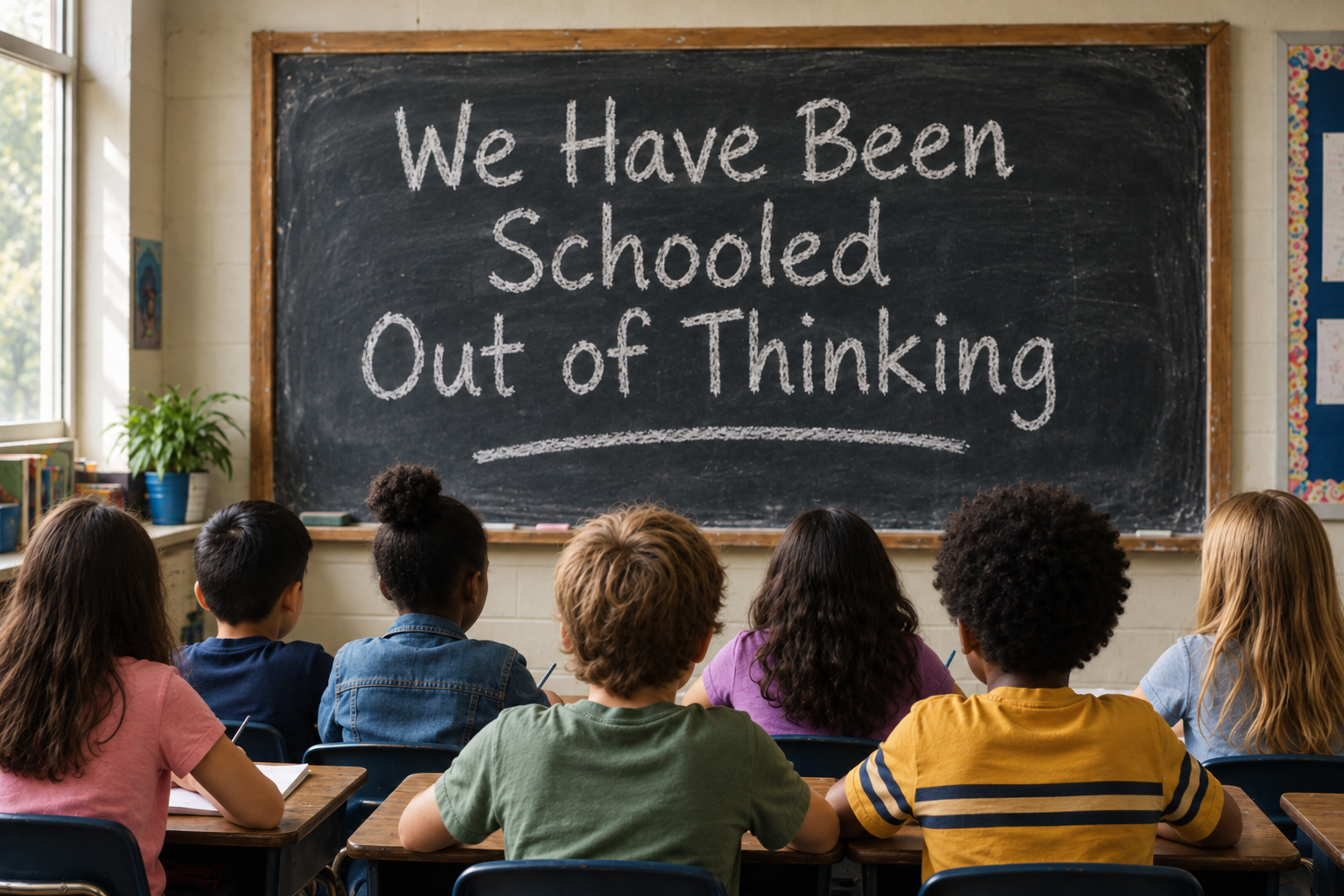
Because I don't believe our difficulty is simply that people are unwilling to think. I think many of us have become extraordinarily good at doing precisely what our educational and professional systems have rewarded us for doing, finding the answer. We learn the material. We answer the question. We follow the procedure. We demonstrate competence by arriving at an acceptable response. There is considerable value in all of this. Literacy, knowledge and expertise matter enormously, but, somewhere along the way, finding the answer became confused with thinking.
And then along comes AI.
When answers become abundant
For most of our lives, access to information has been a constraint – if you wanted to know something, you had to know where to find it, or know someone who knew it. Education therefore placed enormous value on acquiring, retaining and retrieving knowledge. Generative AI changes that relationship.
I can now ask a question and receive a coherent, sophisticated answer in seconds. I can ask for ten alternatives. I can have the answer challenged, rewritten, expanded, simplified and supported with evidence. The production of an answer has become extraordinarily cheap. That does not make knowledge irrelevant. Quite the opposite, actually. Knowledge gives us the context with which to evaluate what we receive.
What does change, is where some of the human work lies.
The question increasingly becomes not simply, Can I find an answer? But rather, What do I make of the answer I have been given?
And from there:
Is it correct?
What assumptions are embedded in it?
What is missing?
Why does this answer appeal to me?
What happens if I reject its premise?
What other possibilities have not been considered?
What should I do?
And perhaps most importantly, Who is responsible for that decision?
The answer to the last question remains human.
This is where algorithmacy becomes interesting.
Roger defines algorithmacy around a form of coordination in which one human party coordinates with another through an algorithmic third party. That distinction matters. We aren't simply using increasingly sophisticated tools. We are increasingly living and working inside systems that mediate what we see, what others see, which choices become available, how our actions are interpreted and what happens next.
The worker, customer, student, creator, manager or citizen therefore has to do more than understand how to operate the technology. They have to perceive the system in which they are acting. They have to notice, interpret, question, adjust and exercise judgement. That is why I think the difficulty people may initially have with the idea of algorithmacy is interesting in itself.
AI and algorithms remain, for many people, inside a mental category labelled technical, new, complicated or not for me. Yet we are already coordinating through them. Perhaps the problem isn't simply that we don't understand algorithms. Perhaps we have spent a long time being taught to use systems without necessarily learning to see them.
Thinking is developmental.
It is not a switch that can simply be turned on by the admonition to “start thinking.” Thinking encompasses curiosity, which can be strengthened, and judgement that can become more discerning through practice. Thinking involves becoming more aware of uncertainty and our assumptions. We can learn to remain with uncertainty rather than reaching immediately for resolution. We can become better at separating ourselves from an idea we have invested in. We can learn to recognise when the question itself needs to change. These are capacities. That means they can be developed. And that matters enormously in the age of AI.
The connection I hadn't fully seen
This is where Roger's argument helped me see my own work differently.
I have been developing The Deliberate Human a learning experience based on the Nine Disciplines of a Facilitator developed by John and Maureen Jenkins, reframed for AI-assisted work. The disciplines were never about technology. They were about the person doing the work. That is precisely why I believe they matter now.
Consider the discipline of Detachment.
AI can produce an answer that is articulate, persuasive and beautifully structured. We may have spent an hour refining the prompt that produced it. It may validate something we already believe. Can we still walk away from it?
Detachment allows us to care deeply about the quality of an outcome without needing that particular outcome to validate us.
Or Intentionality.
Before asking AI to act, I ask, Do I know what I’m actually trying to accomplish? Am I directing the tool toward my purpose, or gradually allowing what the tool can conveniently produce to redefine the purpose for me?
Then there is Sense of Wonder.
Curiosity matters because AI is exceptionally good at giving us plausible answers. Wonder keeps us asking what else might be possible. And creativity goes further still.
AI can generate alternatives from patterns contained within what humanity has already produced. Human beings can imagine, associate, dream, question and create things that did not previously exist.
We should be very careful not to relinquish that capacity simply because generation has become easy.
The human work moves upstream
Perhaps this is one of the most important changes AI is producing. As machines become better at generating outputs, more of the distinctly human work moves upstream.
What are we trying to accomplish?
What question should we be asking?
What deserves our attention?
Which assumptions should be challenged?
What does this situation mean?
What possibilities can we imagine?
What should we choose?
And what responsibility do we accept for that choice?
These are not primarily prompting questions. They are questions of judgement and agency.
Algorithmacy gives us a way of thinking about the competency required to coordinate through algorithmic systems. But recognising the new coordination environment is only part of the challenge. We also have to develop the human being operating within it.
That is the connection I now see much more clearly between algorithmacy and The Deliberate Human. One helps us name the environment. The other asks how we strengthen the human capacities required to navigate it deliberately.
Perhaps we need to learn to think again
I don't believe AI is inevitably making us less capable of thinking. But I do think it creates an extraordinarily seductive opportunity not to. Why struggle with the blank page when something can fill it? Why wrestle with competing possibilities when something can recommend one? Why construct the question when something will happily answer the first one we give it?
The danger isn't simply that AI will think for us. It is that we may stop noticing which parts of thinking we have handed over.
So, Roger's provocation ultimately lands with me. We do need to start thinking. I would simply add one thing. If we have spent decades building institutions that reward finding the answer more reliably than questioning it, then “start thinking” cannot only be an admonition. It has to become a developmental project.
And perhaps that is one of the most important educational projects of the AI age.
About the Author
Lorraine Villaroel is an AI builder, transformation facilitator and community catalyst exploring the intersection of technology, education and human development. Through her writing, projects and collaborations, she examines how we can embrace emerging possibilities while cultivating the wisdom, judgment and inner growth needed to thrive in a changing world.
She writes Beyond Now at WebblyWeb, exploring who we are — and who we are becoming.