
The Deliberate Human
For the better part of a century, the brightest minds amongst us have toiled at reverse engineering our intelligence. Notwithstanding we couldn’t quite figure out consciousness and, we don’t fully understand how the brain produces thoughts, we’ve proceeded on a path toward artificial general intelligence.
Learning to Trust Our Own Thinking
As in every other time in the history of our existence, we as humans are faced with a problem. For the grander problems, we’ve created gods to deal with them - and with us. I’ve always thought that interesting and quite a bit paradoxical. We created gods and imbued them with human qualities - love, anger, vengeance - and then determined that we must have godlike qualities - forgiveness, peace, contentment. I’m not sure how that was supposed to make us better humans, but, somewhere along our journey, it may have dawned on us that it wasn’t quite working. Now, it seems, we’ve decided to recreate ourselves.
For the better part of a century, the brightest minds amongst us have toiled at reverse engineering our intelligence. Notwithstanding we couldn’t quite figure out consciousness and, we don’t fully understand how the brain produces thoughts, we’ve proceeded on a path toward artificial general intelligence.
Now, we’re sitting at the tip of the arrowhead. We may not have clearly defined the problem we’re attempting to solve but we’re careening toward a truly ambiguous future. Let’s be clear here, I know this is an over-simplification. It’s like sitting on a hill overlooking a valley of flowers as the sun rises and then reproducing on a canvas, just two rows, one reddish yellow and the other deep green. The details left to the imagination.
This is not a doomer post, nevermind that I’ve wandered down what seems to be a naysayer’s path. Setting aside for the moment all the wonderful discoveries that AI will enable us to make, let’s observe its impact on our daily humanness.
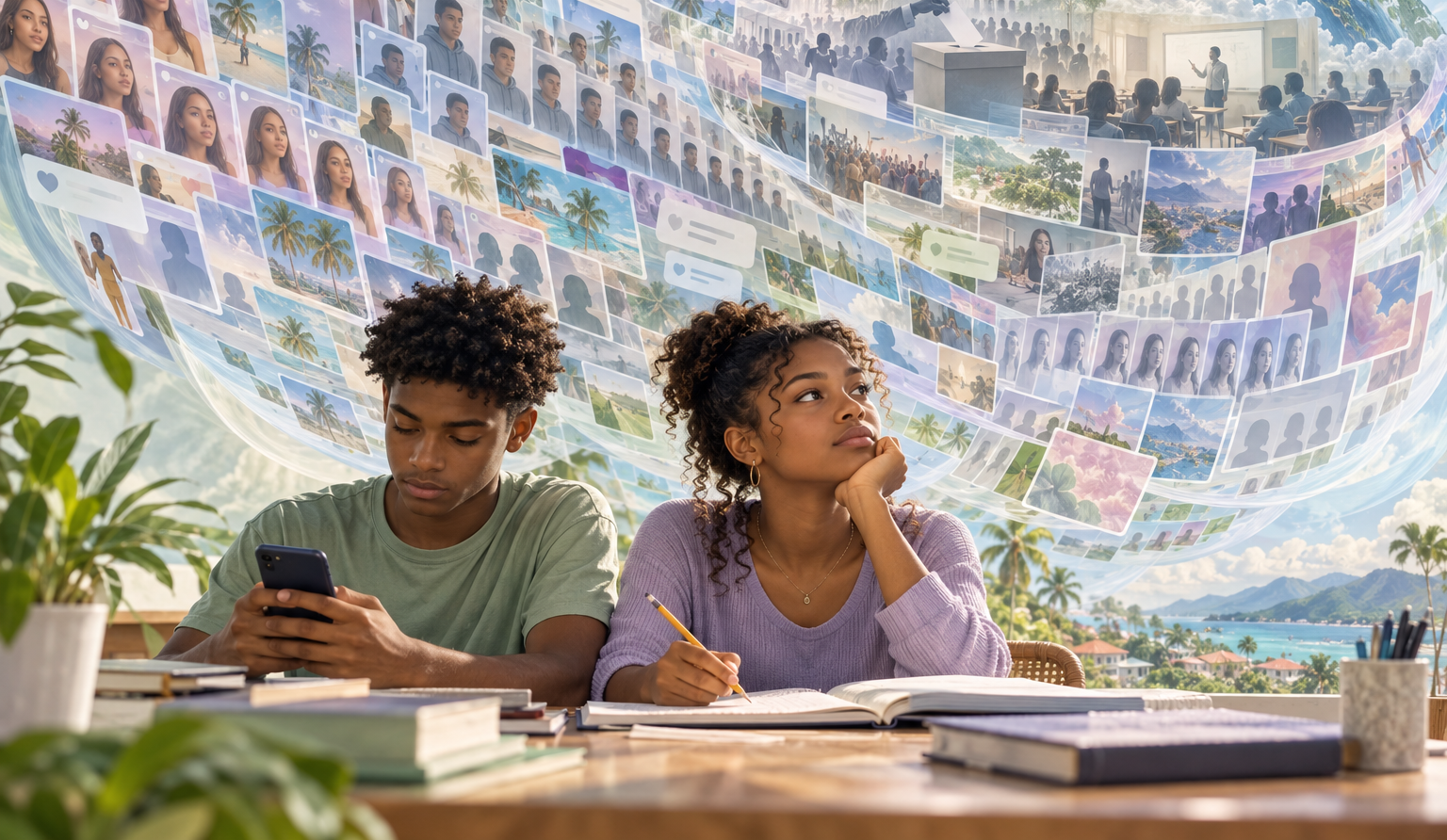
Pre 2023, we were already held in peril by the effects of social media on our teens, and through the revelations regarding Cambridge Analytica, its impact on elections and global democracy. Then, in November of 2022 we were presented with ChatGPT and the fastest uptake of any previous software. A brief four years hence, AI is central to an enormous and growing share of the material we encounter online, while some content is generated almost entirely by large language models; the internet is now flooded with what we’re calling AI slop and the education systems globally are concerned about the future of human thought and creativity.
And it is at this juncture I insert myself.
The advancement of technology has always fascinated me. I’m old enough to remember the introduction of computers at the bank I worked at and young enough to have been using ChatGPT since February 2023. And I’m fortunate enough to have learnt the value of self-reflection early enough in my adult life to have developed the capacity of the detached view.
From my vantage point, what do I see? A mature female, wife, daughter, sister, mother of four, grandmother of three. She’s been journalling since 1991 and believes deeply in the concept of personal social responsibility. For many years she facilitated organisations through the development of customer service strategies and once had a column in a local newspaper dedicated to customer service. She created a programme called The Interior Journey and included it in her facilitations. She’s also written a few self-reflection articles because she also believes that the life examined is the life that can be improved.
Recently, she’s been hesitant to write anything without running it through ChatGPT. And that gave her pause.
At this point I had to ask myself a series of why and what questions. And I realised that in my use of AI I had inadvertently nurtured my propensity to self-doubt and diminished my capacity to endure failure. I’m not a great writer by any stretch of the imagination, but that has certainly never stopped me from writing. Probably because I was confident in my ability to communicate and that I had something worth communicating – whether someone else thought so or not.
Paradox, it would seem, is intrinsic to human learning and growth – to our evolution. Failure is a necessary part of success. Our darkest journeys can lead to personal illumination. Our mistakes lead to our eureka moments.
I am an advocate for AI-enhanced learning and I am currently honing my skills as an AI engineer. The issue isn’t that “it” will replace us. It is that we will surrender our independent thought to it.
Not understanding the value of our thoughts or of our inner selves, unfortunately, is not new to our existence. We have millennia of philosophical writing at our disposal imploring us to examine ourselves so that we develop awareness of the inner self. This exercise of recreating our intelligence, however, has placed us at a moment where more than ever, we need to heed these teachings.
As our use of AI in every aspect of our work and personal lives increases, we need to practice awareness of ourselves and deliberately nurture independent thought.
In my work facilitating facilitators, I incorporated the Nine Disciplines of a Facilitator by Jenkins and Jenkins into my facilitation; as a developing AI engineer, I’ve created a learning app centred around those disciplines for anyone using and making decisions with AI.
The Deliberate Human is in its early stages of development and is designed to help you examine your response to the influence of AI and aid in strengthening the judgment, self-awareness and human agency needed to use AI without surrendering your independent thought.
I welcome your feedback.
Introspection is not new. What is new, is the urgency with which we must embrace it. If AI is to become more present in our thinking, working and deciding, then self-awareness cannot remain a private or occasional practice. It must become a deliberate exercise in how we preserve our human judgment, creativity and agency.
About the Author
Lorraine Villaroel is an AI builder, transformation facilitator and community catalyst exploring the intersection of technology, education and human development. Through her writing, projects and collaborations, she examines how we can embrace emerging possibilities while cultivating the wisdom, judgment and inner growth needed to thrive in a changing world.
She writes Beyond Now at WebblyWeb, exploring who we are — and who we are becoming.